About
Multidisciplinary Visual Artist
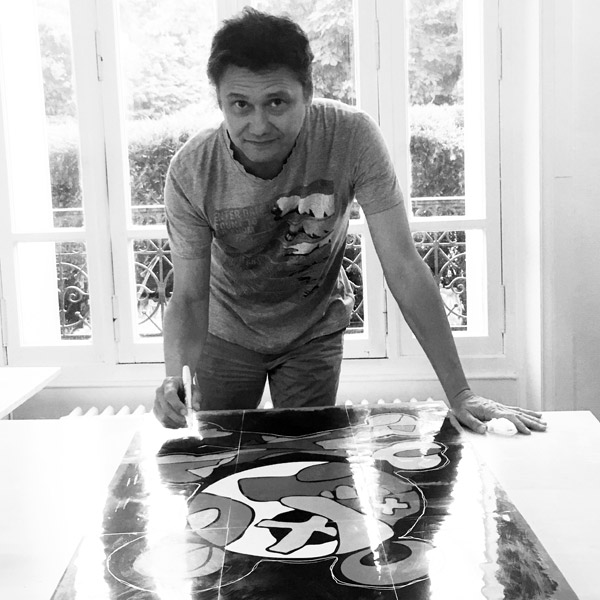
Toma Pilicer’s practice resolutely dissolves boundaries between painting, digital imagery, and spatial experience. His work emerges at the intersection of abstraction and memory — a visual language that activates image and surface as archives of psychological and perceptual transformation.
Pilicer’s canvases and digital compositions coexist as parallel ontologies: painted surfaces that shift between figuration and flux, and algorithmic images that interrogate the construction of visual presence itself. For Pilicer, painting is not a representation but a record of perceptual cognition; digital processes are not tools but terrain for conceptual exploration.
Across mediums, Pilicer reconfigures familiar visual elements into hybrid topographies, where color becomes a horizon of affect and form oscillates between emergence and dissolution. His practice is driven by a central inquiry: what is an image when it can no longer be grasped as an object? This tension informs motifs of fading, echo, threshold, and absence. Images become remnants of cognition — traces, scars, or palimpsests.
Working between Asia and Europe, Pilicer’s work refracts cultural and perceptual dualities without synthesizing them into closure. Instead, he amplifies contradiction — between chance and control, organic and synthetic, silence and resonance — allowing their friction to become the locus of experience.
Pilicer’s art occupies a space that is simultaneously introspective and outwardly speculative. Whether on canvas, pixel, or installation, his work extends a persistent call: to see beyond the visible — into the conditions that make vision itself possible.